The Journey of Art Starts With Self Acceptance Coons
Jeff Koons Is the Most Successful American Creative person Since Warhol
Then what's the fine art world got against him?
Koons holding a gazing ball aloft in his studio alongside several sculptures destined for his show at David Zwirner. Photo: Martin Schoeller/New York Magazine
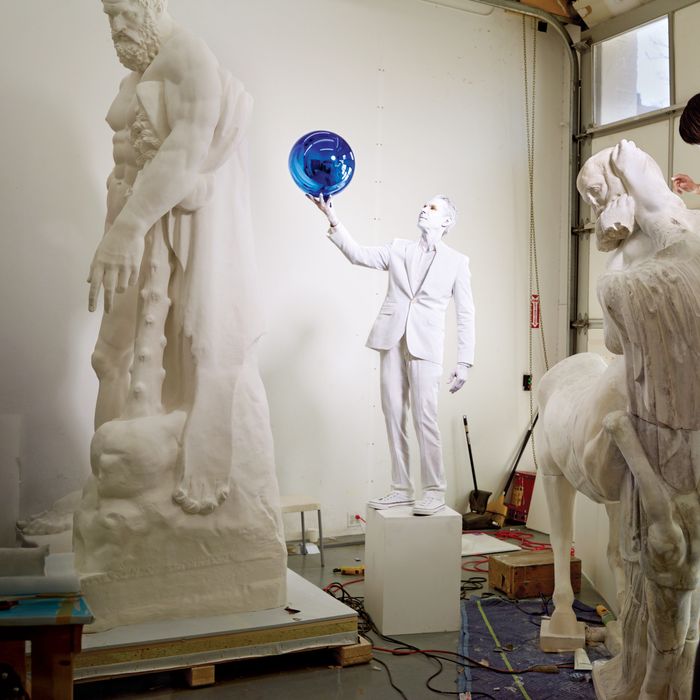
Koons holding a gazing brawl aloft in his studio alongside several sculptures destined for his prove at David Zwirner. Photo: Martin Schoeller/New York Magazine
Koons holding a gazing ball aloft in his studio aslope several sculptures destined for his show at David Zwirner. Photo: Martin Schoeller/New York Magazine
Honk Honk Honk! Honk!
Jeff Koons'due south five-yr-old son, Eric, is bravado a yellow plastic toy horn in his face, and the preternaturally unruffled creative person is, for a human second, irritated.
"Finish," says Koons. "No bravado the horn."
"It's mine," Eric says.
"It's non yours," Koons says. "It's Dad's." Then he deftly takes information technology from Eric, handing it off to one of the children'southward caretakers.
Nosotros are standing in the middle of Koons'south quarter-city-block West Chelsea studio complex with the six children he has with his wife, Justine, who worked here earlier she married him; their nannies; and his extremely nice assistants, who exude an almost midwestern courteousness.
I'one thousand in the capital of the Koons empire, an earnest and well-capitalized toy-chest kingdom quite sheltered-seeming from the raucous galleryland that ends a few blocks southward. The place is an industrial procession of hushful rooms, staffed by shut to 130 by and large immature people. Koons's artwork is intensely labored, in guild to look like no human manus was ever actually involved. At that place are guys at computers with 3-D-imaging programs, in forepart of a cream mock-upwards of a ballerina statue he plans on having carved in stone with lasers to get the delicate grid of the tutu simply so. In that location'due south a tall fluorescent-lit painting hall with rolling wooden scaffolding, and so Koons's painters tin achieve the peak of the paint-past-numbers canvases. There's a room that looks like a robot infirmary from the far-off time to come where diverse parts of bronze-bandage Hulk sculptures are being carefully attended to; in that location's a storage room with containers marked for old inflatable toys that are Koons's most well-known muses; and there's a room behind an air-lock door in which people are dressed in protective suits similar on Breaking Bad.
It is a big functioning, and everyone makes way for Koons. The 58-twelvemonth-sometime artist is polite, proprietary, aware of every tiny detail around him, his center on a meticulous hunt for deviations from his vision. As he surveys the labor, he drinks from his Led Zeppelin coffee mug (he's a huge fan) and tells me his other main mug has a flick of the stubby totemic Venus of Willendorf, a 25,000-year-one-time carved effigy plant in present-day Republic of austria, a longtime fascination of his and also the subject of an elaborate stainless-steel sculpture he'll be showing this week in New York. "I believe that fine art has been a vehicle for me that'southward been about enlightenment and expanding my ain parameters, to give me courage to exercise the freedom that I have in life," he tells me. "Every day I wake upward and I really endeavour to pinch myself to have advantage of today and to use that freedom of gesture to do what I really like to do."
Three decades into a choppy only astonishingly high-profile career, Koons remains something of a boy wonder—a trim, soft-spoken, systematic, and tightly scheduled puppet master who speaks in a reassuring near singsong, his linguistic communication all patient, bright-eyed affirmation, every bit if reciting from a well-worn, well-worked-out self-help text ("Removing judgments lets y'all experience, of course, freer, and you have acceptance of things, and everything'southward in play, and it lets you get further"). He is unflappably kind, nigh daydreamy, and speaks so unlike nearly artists, with their anxiously self-justifying obfuscatory bookish jargon, that you wonder, every bit everyone always has, if you lot are encountering a sort of put-on—a Method operation of childlike mystic wonderment. ("I always have thought that kind of walking out of Plato's cave is really the removal of anxiety and the removal of all judgments," he says). "What he says about his work—it is an extension of his work," says his friend and onetime dealer, Jeffrey Deitch, at present the director of L.A.'s Museum of Contemporary Fine art. "For Jeff, the work does not stop with the object. Information technology'south a whole vision of the world and a whole vision of art and life which is Jeff Koons."
The effect is a bit frustrating only also soothing. You remember his vocalisation more what he says, and his pastor-and-naïf affect suffuses the entire vast, white-walled studio circuitous, which seems every bit happy and purposeful equally any Internet startup. Office hours offset at a Bushwick-unfriendly eight a.m., and in these last weeks of preparation earlier his first New York gallery evidence in a decade, the painting studio is running in 3 calm shifts.
The piece of work existence done is actually not for one testify but two, at probably the city'south most powerful galleries: Gagosian, which has represented Koons since 2001, after product costs derailed his partnership with Deitch (one person who knows him says, "His perfectionism basically bankrupts everyone who works with him"), and gallerist David Zwirner, the ambitious and prosperous younger rival to Larry Gagosian, who instigated an art-world gossip kerfuffle when he announced in the fall that Koons was doing a show with him. Both shows open this calendar week, simply what ane curator a few months ago called an art-world "battle royale"—the 2 megadealers competing over the work of a super-profitable creative person—has settled into something else, and only mayhap what Koons wanted all along: the beginning of a Year of Koons, culminating in summer 2014's total-career retrospective at the Whitney Museum—its last exhibition in its Madison Artery headquarters before moving to the bottom of the Loftier Line. At the park'due south other end, Koons is hoping to suspend a total-size replica locomotive from a crane, nose down.
Koons is, by the mensurate of sales of new work, which is the money-mad art earth'south only objective measure, the most successful living American artist, but he has never before had a museum retrospective in New York, his dwelling house base for 36 years. And information technology'south clear that, for him, one is not plenty. "Even though the Whitney has given me the Breuer building, at that place yet isn't that much infinite," he says, explaining why he's staging these two simultaneous shows after such a long hiatus. "In that location'southward a lot of work that unless people see it at present, they may not see it then."
The gallery shows volition both exist opening during Frieze calendar week, when the bespoke London-bred art fair descends on New York and makes the metropolis not just the center of the global art earth but its entire circumference. And it says something of Koons's celebrity and symbolism that artist Paul McCarthy is going to exist displaying a huge joke about Koons there: his own eighty-foot-alpine inflatable balloon dog.
Koons has made his name manufacturing toys for rich old boys—exacting pagan monuments to mass-culture triviality, like his stainless-steel balloon animals or vibrantly colored metal Popeye, which he calls a self-portrait—and along with Damien Hirst and Takashi Murakami, he is i of a small group of ability-Popular impresarios who helped define the aughts as an era of large-scale spectacle. And displayed wealth. (His collectors include Eli Wide, Dakis Joannou, Steven Cohen, and the royal family of Qatar.) A brand-new work by Koons, like the man-size statuary Hulk sculptures he'due south been producing of late, is said to run between $4 million to $half-dozen 1000000 and is ordinarily pre-bought past his collectors. (The final decades' bull marketplace in art means Koons is operating in a very different price climate than Warhol, Rothko, or Pollock ever did.) Older piece of work, at auction, goes for even more than; a few years dorsum, Adam Lindemann sold his Hanging Heart—a stainless-steel sculpture based on something Koons saw in a shopwindow display and supersized—for $23.6 million at Sotheby'southward reportedly without ever fifty-fifty unwrapping information technology and taking information technology dwelling house. (Gagosian bought information technology, probably for a client.) Last fall, a Tulips sculpture was sold (to casino magnate Steve Wynn) at Christie'southward for $33.seven meg. The circle of collectors and dealers is so small and then awash in greenbacks that the process tin can seem to an outsider a bit like a rigged game, in which a bad bargain can be considerably more valuable than a good one. If yous buy a giant balloon toy for $30 million, you may have spent a few million more than you lot had to or even expected to; just you've set the value of that work and likewise elevated the value of all of the balloon toys in your collection. Which is especially good, since there aren't very many people who can afford to spend $30 million on a giant balloon toy, and those who can tend to take pleasure in cornering a marketplace.
Much has always been made of the fact that Koons is in league with the plutocrats and once worked on Wall Street, selling commodities. Simply he's always been quick to refuse the art earth'south carefully patrolled shibboleths—that work has personal meaning, that it must comprise some social criticism, that it limited ambivalence about the art market. Koons does non brand ambivalent work, which is his mode of giving people what they actually enjoy: a lavishly elevated version of mass-cultural charisma. Koons has long aspired to the ubiquitous popular stature of Michael Jackson, whom he once paid weird (and famous) tribute to with a large porcelain sculpture of the vocalizer and his admiring pet chimp, Bubbling. But a closer model might exist Andy Warhol, who was similarly attentive in his talk near the importance of just liking things without judgment, though he smuggled enough military camp sensibility into his work to brand information technology seem slyly subversive. At that place is aught subversive in the way Koons works or the fashion he talks. "Self-acceptance and credence of others" is one of many koanlike out-of-the-blue affirmations he recites to me. "Acceptance of everything." As Zwirner tells me: "He says if y'all're critical, you're already out of the game. " Deitch strikes a sweeter note: "I think Jeffrey's love of children and family—that connects to his try to retain that childlike inspiration, to understand how children perceive."
The idea of adolescence is everything to Koons: He'south a bit like Norman Rockwell in that way. (Remember enough well-nigh Koons and yous start seeing just near everybody in him.) That might seem like an odd observation to make most someone who owes his fame beyond the art world to the piece of work that was likewise his greatest professional and personal heartbreak—a much-derided-at-the-time series of photo-realistic paintings and sculptures of himself and his then-married woman, Ilona Staller, an Italian porn star who went past La Cicciolina, copulating gauzily (and, in some cases, non so gauzily). Simply to hear him tell information technology, he really idea he was making piece of work everyone could identify with, to help salvage usa, he says, of "guilt and shame." When he was nevertheless married to the porn star, who inappreciably spoke English and to whom he spoke either through a translator or Koons's peculiar pidgin-Italian-accented English, he told Vanity Fair that "the sculpture that I am nearly interested in is our child. I don't believe that marble bust I made is my style to enter the Realm of the Eternal. To me the merely way to be in the eternal is through biological sculptures." Later, he said he dreamed of opening a museum to which children would drag their parents.
What's new in the Gagosian and Zwirner shows is that he'southward trying to place himself in art history—quite literally, by placing art history in his piece of work—dragging classical statues onto the canvas or casting them in plaster. His references this time are Picasso and Praxiteles. In that location volition be a mirror-polished classical Venus statue and 1 that takes his big cast-in-metal balloon-animal sculpture in a different direction: Airship Venus. His balloon-twisting consultant, an L.A. balloon artist named Buster Airship, told me it took him 85 versions using a threescore-inch-long airship to get that one right; Koons then cat-scanned the actual airship sculpture, to make sure he got the measurements exactly.
"1 of the main reasons that I work with inflatables is that the attribute of inside/outside—if you lot await at an inflatable and you lot think about it, it seems very empty inside," Koons tells me. "Oh, information technology's air in there, and so it'due south empty. But that moment that your exterior space around y'all feels denser, it gives you more than of a sense of confidence in the world. You recall about your own inside. It's denser. Information technology'south blood, it's guts, information technology's tissue. Then if you're not around that concept of the inflatable, it's more than of a void out there. Okay? It's denser inside here than exterior. It's vacuums. But when you lot're experiencing an inflatable, for that fourth dimension, it's vacuous inside that object and it's empty within." I ask if he always talked this manner about his work. "In some mode," he answers. "I've had time to think almost these things."
Walking effectually the studio, he shows me a checkerboard piece that alternates between Titian's Venus and Adonis and Picasso'south blackness-and-white The Kiss from 1969. Koons has said the Titian painting is among his favorite of all time: She's naked, wanting Adonis to hang out; he'south dressed and heading out with the dogs to get hunt. Koons owns The Osculation and says "it really helped change my life." An aging Picasso is having this "whole dialogue with his own mortality," he says, explicating more the painting, it seems. (Several works are layered over a background by the turn-of-the-century painter Louis Eilshemius, "who screamed for l years for recognition in the face of an apathetic globe," according to his poetic 1941 Times obituary.) Superimposed on the checkerboard is the paradigm of a Uli figure, a sacred wooden statue that comes from Papua New Guinea. They're used in funerals and fertility rites and correspond tribal leaders, "just they're both masculine and feminine, because they can protect their community, they can defend the community, and at the same time they can nourish the customs."
Equally they do most every Fri afternoon, Koons, Justine, and their vi children are gathering to drive the 3 and a half hours to their 650-acre farm almost Koons'south childhood dwelling in York, Pennsylvania. The oldest, Sean, is 11 and wearing neon Ray-Bans and a striped stocking cap; the youngest, Mick ("like Mick Jagger"), is just 8 months old. Koons is clearly uncomfortable having his family, and his individual life, made bachelor and public for me even for an afternoon—the feet of a perfectionist focused, for most of his recent career, on removing personal and subjective elements and delivering instead perfectly polished expressions of what he calls "objective" work. And to run across him with the six children—screaming, scrambling, wanting his attending—is to see his lifelong experiment in maintaining himself in a state of artless wonder challenged a bit past their feral reality. But then again, artless wonder is a concept much more useful to adults than to children.
It is ofttimes said that an artist like Koons works at the pinnacle of the art world—a unmarried piece could pass as barter for a glass-walled condo at One57. But information technology would probably be more than accurate to say that he works above the fine art world, in a rarefied, barely occupied penthouse beyond the reach of critics, curators, other artists and other dealers who brand upward what is unremarkably called the art Establishment. That Establishment doesn't just ignore the work of the unknown creative person but also, for the virtually part, that of the world-famous—especially Koons, Hirst, and Murakami, who have become and then big and and so rich information technology no longer seems important to have opinions of them. Instead, they are talked about as cultural phenomena about which one should have ideas—balloon dogs, reality boob tube, Occupy Wall Street. Like Warhol, Koons is a Pop artist who is himself a Pop figure, one who gets to hang out with the world's richest collectors, who can afford to fund his visions of the unsullied magical object. "The desire that Koons creates with people is very much most possession," says Tobias Meyer, worldwide head of contemporary art at Sotheby's. "It'due south nigh owning information technology, ingesting it. It'due south proto-sexual. The ability to take the physical proximity to this object."
"He exists as a kind of fascinating artistic limit-example," says Scott Rothkopf, the curator of the retrospective. "Of fabrication. Of the size of one'due south audience or celebrity. Or of risk-taking and impassioned commitment to i's work." In an essay on the "Hulk Elvis" paintings, Rothkopf wrote, "What he is selling is not only a painting or an optimistic dream of youth and love, but the dream of a perfect object … an extremely backbreaking and expensive process, and his paintings are about that, too … they are too about the people who are willing to pay for them."
Most self-fabricated people consider themselves outsiders, no thing how at the center of things they detect themselves. And role of Koons's self-understanding is that he'south keeping his past with him. The farm to which Koons is retreating with his clan was originally his grandmother'south, which he bought back in another kind of nostalgic preservation of the idea of his babyhood. During the week, he and his brood live uptown nearly the good private schools. Merely you go the idea their existent domicile is in the countryside with their sheep and Icelandic horses. "The kids don't fifty-fifty like to go to Key Park anymore," Justine tells me every bit she corrals them. "Too many other people."
Koons has had a very long career. When he began making headway in the early eighties, the city was giving itself over to the painterly swagger of the neo-Expressionists: David Salle, Julian Schnabel, Jean-Michel Basquiat, specially. Koons's stuff was in another register, starting with gear up-mades of junky plastic things he found in shops on 14th Street and in Chinatown. Subsequently, he moved on to putting vacuums within fluorescent-lit clear Plexi cases: This serial was chosen "The New."
Readymades like these can be seen every bit ironic critiques of article culture, domestic labor, generalized deep-pile-carpeted anomie. But Koons has ever had an nearly animistic interest in the ordinary, store-bought thing, and to him that work is and was a securely earnest tribute to late-industrial perfection. He paid for production (vacuums are expensive) with the coin he made on Wall Street. "I was good at selling," he once told an interviewer nigh that gig. "A lot of my piece of work is nigh sales. And it was near being independent from the art market. So I didn't have to buss anybody'southward ass. And that I could make exactly what art I wanted to brand."
The art he wanted to make was peculiar. First, a sink-or-swim show called "Equilibrium"—basketballs floating in vitrines of water, drolly framed Nike basketball-culture posters, and statuary casts of a lifeboat and a flotation vest. Then one near the furnishings of advert, class, and alcoholism, "Luxury and Degradation"—painted ads for booze, accompanied by steel models of things similar a suitcase travel bar or an ice bucket and an old-fashioned train, each car a little bottle of Jim Beam. This was followed, after in 1986, by "Statuary" (his famous "inflatable" bunny, cast in stainless steel) and then 1988's career-making "Boiler."
And then he met Ilona Staller and lost his equilibrium. He saw her in an outcome of Stern magazine in 1988: She was wearing a come across-through clothes, and he used the photograph as the model for a sculpture called Fait d'Hiver, where a naked woman is lying in the snow, joined by a penguin and a pig. Staller was a member of the Italian Parliament as well as a porn star. The next year, he sent her a fax, and they met upwards. He in one case described meeting her backstage at a show she was performing in: "I enjoyed very much that she was standing at that place without whatsoever pants on." She was "one of the greatest artists live. She was able to present herself with absolutely no guilt and no shame." He had the idea that they would make a porno film together, and they took lots of photos where they were having sex with each other, which Koons turned into paintings and sculptures called "Made in Heaven." And which are, for all the ways they anticipated an age of celebrity narcissism and porn wallpaper, even so shocking: horrifyingly unguarded, emotionally raw, and sexually explicit—specially difficult to take at the elevation of the aids crunch. "Jeff had dislocated fantasy with reality," Deitch once told The New Yorker. "It was as though he felt the 'Made in Sky' work wouldn't exist authentic unless they were married."
When it came to New York from the Venice Biennial, the work generated a lot of attending but didn't sell much. Museums weren't interested; the art world was embarrassed by him. Koons was given but i more New York solo gallery show in the nineties. And on height of all that, he and Staller split upwards.
And then things got worse: He and Staller had a son, Ludwig, over whom they presently began an expensive and dispiriting custody battle. Koons split with his then-gallerist Ileana Sonnabend (who'd advised against the union). And in a fit of disappointment and self-loathing, he destroyed many of the "Made in Sky" pieces. He had exposed himself, and been humiliated.
His comeback started with Puppy, from 1992, which finally made its style to Rockefeller Plaza in 2000. A 40-foot-tall West Highland white terrier, covered in 70,000 flowers, it was an eager and unavoidable critical and public success. New York's Jerry Saltz named it the public art event of the aughts, calling Koons a "driven perfectionist in pursuit of unconditional love."
In a kind of retreat-and-recovery mode, Koons began photographing elementary objects that pertained to life's transitions—block, an egg, a diamond ring—and realized that he should brand sculptures out of them. The thought was a sort of tribute to his lost son: They were also objects from a child's party, and Koons wanted Ludwig to know he was thinking about him. This began the "Commemoration" series, which immune him to slowly crawl dorsum to the top. Just in doing so, he lost the critics—who had always been a bit skeptical, thinking of him, as the Times put it in 1991, as "one concluding, pathetic gasp of the sort of self-promoting hype and sensationalism that characterized the worst" of the eighties. In 2004, Robert Hughes wrote that Koons is "an extreme and self-satisfied manifestation of the sanctimony that attaches to big bucks. Koons really does think he'due south Michelangelo and is non shy to say so. The meaning affair is that at that place are collectors, especially in America, who believe it. He has the slimy balls, the gross patter about transcendence through art, of a blow-dried Baptist selling swamp acres in Florida."
All of this criticism is, ultimately, valid, if somewhat beside the indicate: Koons's piece of work is impersonal, repetitive, awe-inspiring but largely uninsightful, uninflected with whatsoever of the ambivalence about the globe we live in today that animates virtually critically lauded contemporary fine art. Only that doesn't seem to be what he's trying to do anyway. "I am very witting of the viewer considering that's where the art takes identify," he once told an interviewer. "My piece of work really strives to put the viewer in a certain kind of emotional state."
What a airship dog or a puppy made of flowers or a shiny hanging-heart sculpture offers is a picture of industrial perfection, a naïve piece of uncomplicated dazzler that tin be appreciated without using words like discourse. Which is ane very clear reason why he is held in such unsteady regard past critics and curators and is so honey by spectators. As a reflection of the world in which it was made—a Pop universe of digestible wealth—it is mayhap as profound a picture as the work of Warhol'due south was of his.
Tobias Meyer calls Koons's work an expression of Disney-similar "pathological optimism" and compares what he does to Bernini'southward work at Villa Borghese. "1 of the things which comes back to him, positioning himself equally a gimmicky master," Meyer says, is "perfection. Which is something that was for a long time not a function of gimmicky art, which embraced the nonart of the accident or the imperfect." And which is how Koons tin be the art world'southward great populist artisan, even equally he operates as its most exclusive salesman.
Gazing balls are glass globes, painted on the inside, which were once quite pop suburban-garden features (versions of them sell for about $35 at places like Target.com). Koons remembers them from his childhood in York, Pennsylvania—simple mirrored balls that were somehow, magically, transfixing middle-class status symbols. "People put them in their yards because they relish the visual aspect of the ball, just they really exercise information technology for their neighbors," Koons says. "And information technology really helps emphasize a place. Information technology'southward like a point, and everything is kind of reflected from that point."
It'due south hard to miss, in a collection of work harvesting classical myth, the overtones of Narcissus—the human being really cannot terminate working with mirrors. "Imagine little Jeff Koons walking into some backyard and seeing the globe collapsing into this sphere," Zwirner says, a little wistfully.
The balls that Koons had made at a glass company in Punxsutawney, Pennsylvania, for his new works are nighttime blue, and he shows me how the tonality shifts slightly in the centre. In the series, he installs them on white plaster casts—classical museum bronze and colloquial yard objects, similar an inflatable snowman and mailboxes, rendered in the same plaster cast. Each of these works are priced at $3 1000000 or under—the smallest are in the six figures—and produced in editions of three. At these prices, they qualify as affordable.
In the last few years he put his sculptures on top of the Metropolitan Museum, at Versailles, and then amidst the halls of Liebieghaus in Germany—producing an fine art-history-slideshow lecture leading, inevitably, to him. For now, though, he seems content to insert himself into art history in the nigh literal mode imaginable—by making new work that collages with several-thousand-twelvemonth-old work. "Information technology's about acceptance," Koons tells me, monitoring his assistants across the room as he talks. "That's the reason I similar to work with these external things. I really think that the journey that art takes y'all on every bit an artist is that you first acquire self-credence."
Simply like many preaching that sort of cocky-help gospel, Koons seems still agitated by status feet. And, twenty years after existence spectacularly shunned by the art world for "Made in Heaven," past the need to find a place for himself in the canon—even as an creative person rich enough to re-create it in his studio. Koons'southward systematic literalism of reference, and his prodigious memory and gratis-associative narrative fervor make him a bit like your favorite art-history professor. (Become this human being a mooc!)
"Plaster casts in the nineteenth century were very, very popular," Koons explains, passing one sculpture inspired by mailboxes he's seen in Pennsylvania, with flared V8 exhaust pipes sprouting like antlers out of the side, and a manifold on tiptop. "They'll go from these historical images to something that is everyday, like mailboxes," Koons says, adding that this particular sculpture is nearly "personal identity." At that place's besides an inflatable Christmas yard snowman. And more than mailboxes, all lined upwardly in a row, similar at the end of a land route. "This is a sense of community, in a way," he says. "A fiddling flake, to me, like the art world. And it's likewise at the same time you go kind of the sense of loss. The loss of, I guess, loss of a location, loss of a place, identity."
Dorsum in the painting studio. "Could you movement dorsum here just a flake?" he asks the painters, who silently unlock the wheels of the rolling wooden scaffolding they work on. He points to the sculpture depicted in the center: Greek, 100 B.C., of Aphrodite, naked, swatting a shorter, cloven-hoofed Pan away with her sandal. Eros—the winged baby—floats tickled above her shoulder. "He's after her," observes Koons of Pan with a tiny trace of enjoy. "He'south actually existence aggressive with her. If you look hither at his testicles, his phallus has been knocked off. But if yous look at the support …" There is a buttress betwixt Pan's grade and her thigh. "The back up's a phallus. And the whole energy of the piece, the whole narrative, is a phallus. It'southward telling you everything."
*This commodity originally appeared in the May 13, 2013 upshot of New York Magazine.
maddenthabelloved.blogspot.com
Source: https://www.vulture.com/2013/05/age-of-jeff-koons.html
0 Response to "The Journey of Art Starts With Self Acceptance Coons"
Post a Comment